Free Kicks with Clear Responsibilities
A free kick is an isolated, controlled moment of the game. While a player's technical ability to bend the ball over a wall is paramount for direct strikes, the tactical machinery surrounding the free kick—manipulating the wall, creating false cues, and executing indirect routines—is entirely the responsibility of the coaching staff.
Central vs Wide Free Kicks
The tactical approach drastically changes based on the origin of the foul.
- Central Free Kicks (Zone 14): Direct threats to the goal. Routines here often involve multiple players standing over the ball to disguise the angle and identity of the taker. Manipulating the opposition wall is key.
- Wide Free Kicks: Effectively behave like corners but with better delivery angles. They require coordinated runs to beat offside traps, exploiting the space between the defensive line and the goalkeeper.
Under IFAB Law 13, attacking players must remain at least 1 meter (1 yard) away from a defensive wall comprised of three or more defending players until the ball is in play. Coaches must design disruption tactics (e.g., screening the goalkeeper's line of sight) without violating this perimeter distance.
Wall Disruption & Visual Screens
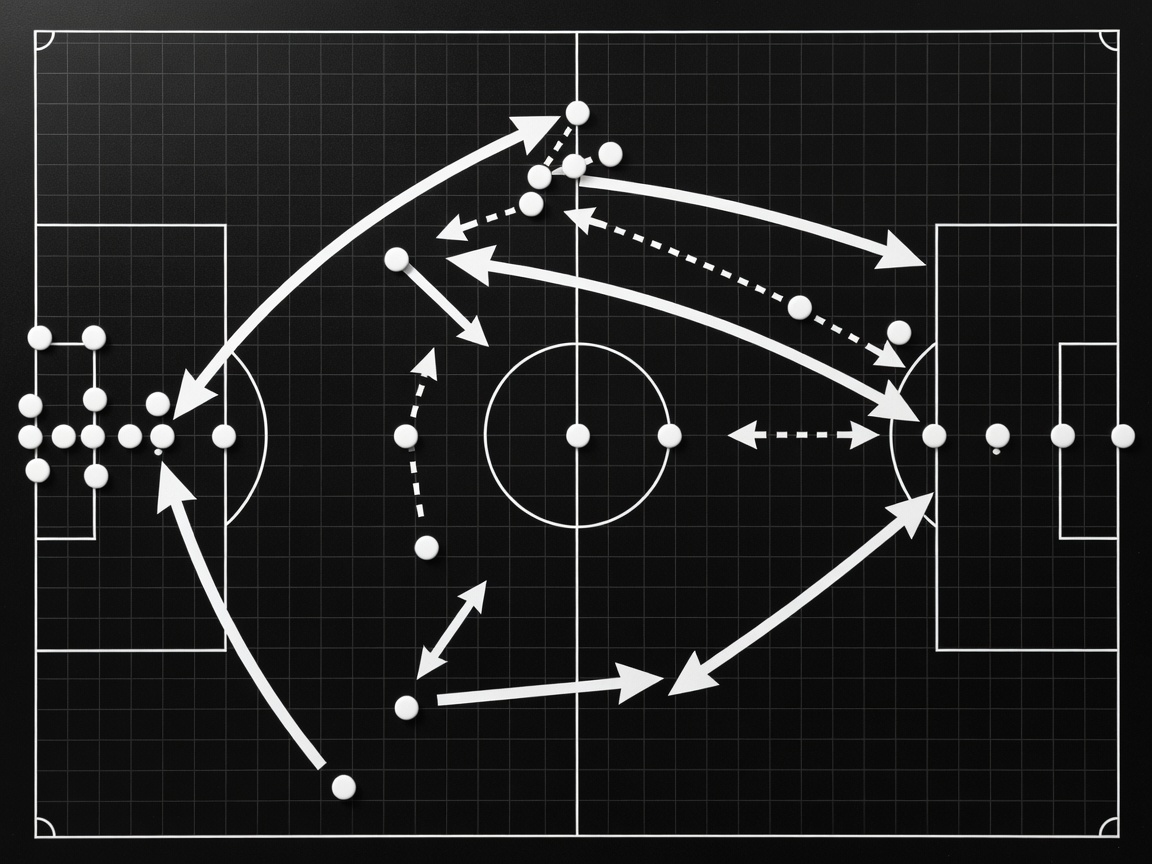
Set-piece specialists like Gianni Vio revolutionized modern free kicks by using attacking players to construct a "false wall" or visual screen. By positioning players slightly offset from the main defensive wall, attackers can:
- Block the goalkeeper's line of sight just before the ball is struck.
- Drop off or duck at the last possible millisecond, clearing a path for a low strike.
- Create confusion in the defensive marking setup if a short, indirect routine is played instead of a shot.
Indirect Routines: The Lay-off and Move
A direct shot is predictable. At grassroots and academy levels, goalkeepers train exhaustively to read body mechanics. Implementing a quick lay-off alters the ball's origin point, forcing the wall to step out and the goalkeeper to shift their feet.
Consider a simple routine: Player A runs over the ball. Player B touches the ball slightly to the side. Player C steps up and strikes. That minimal sideways movement changes the geometrical angle of the shot, frequently unlocking the side of the net previously covered by the wall.
Defending Direct Free Kicks
Conversely, defending a direct free kick requires meticulous structure:
- The Wall: The tallest players occupy the side protecting the near post. Do not jump unnecessarily; jumping underneath a well-struck low ball is a frequent error.
- The Draught Excluder: Utilizing a player lying horizontally behind the wall has become standard practice to prevent low-driven efforts when the wall jumps.
- The Goalkeeper's Positioning: Taking a central-to-far-post stance, trusting the wall to cover the near side.