Defending More Than the First Contact
To construct a resilient defense at set pieces requires more than just assembling tall players in the penalty area. The best defensive structures in European football—such as those seen at Brentford FC or FC Midtjylland—are built on absolute clarity regarding marking assignments, block heights, and the immediate reaction after the ball is cleared.
Marking Systems: Zonal, Man-to-Man, and Hybrid
The debate between zonal marking and man-to-man marking is as old as the modern game. Let's define the structures:
- Zonal Marking: Players guard specific spatial zones in the penalty area rather than opposition players. The advantage is that defenders can attack the ball without being manipulated out of position by dummy runs. The drawback is conceding a running start to attackers.
- Man-to-Man Marking: Each defender is assigned a specific opponent. It simplifies accountability but risks defensive disruption if attackers set screens or execute complex crossing patterns.
- Hybrid Marking: The prevailing system at the UEFA Pro License level. Typically, 4 to 5 dominant aerial players hold a zonal line across the six-yard box, while 3 to 4 players block and man-mark the opposition's most dangerous runners to prevent them from building momentum.
Your best header of the ball should anchor the most vulnerable zone—usually the space midway between the near post and the center of the six-yard box. They must be instructed strictly NOT to vacate their zone to chase a runner; their job is to attack any ball delivered into their designated cylinder of space.
Post-Clearance Line Height
Defending a corner does not end when the first header is won. Often, goals are conceded in the second phase because the defensive line drops too deep or fails to push out uniformly. Once the ball is cleared, the defense must immediately squeeze the space, pushing up to the edge of the penalty box.
This coordinated push does three things:
- Catches lingering attackers offside if the ball is delivered back in.
- Puts pressure on the opposition players positioned for the second ball.
- Transitions the team from a defensive mindset into a counter-attacking posture.
The Role of the Goalkeeper
A proactive goalkeeper significantly alters how a team sets up defensively. If the goalkeeper is comfortable claiming crosses within the six-yard box, the zonal line can afford to set up slightly higher, engaging attackers near the penalty spot. Conversely, a keeper rooted to their line forces the defense to protect the immediate vicinity of the goal mouth.
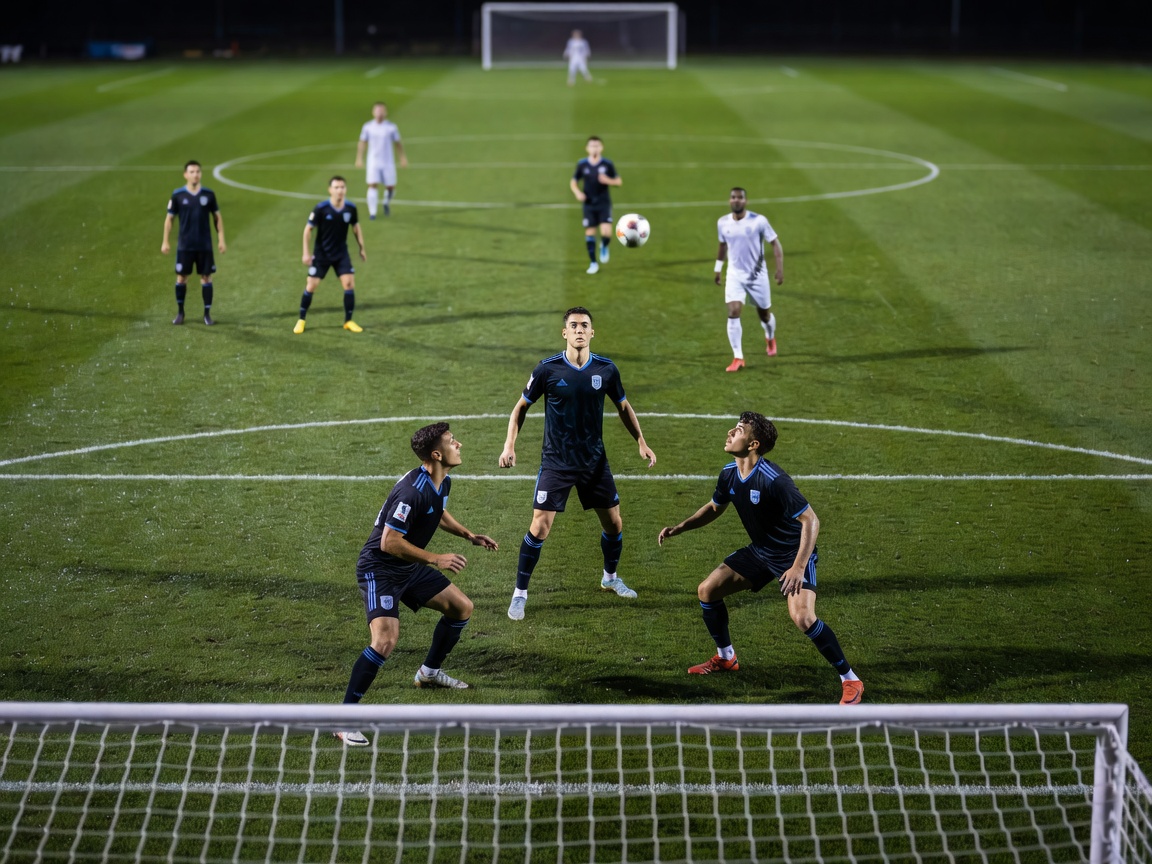
Key Defending Principles Checklist
Before sending your team out, ensure these questions are answered:
- Who is positioned on the front post?
- Are we leaving players up the pitch to force the opposition to keep defenders back?
- Who marks the opposition's designated short-corner options?
- Who is tasked with sweeping the space at the back post?